
Monday, 24 January 2022
D&D Monsters: Umber Hulks


Saturday, 22 January 2022
DW Monsters: Zygons
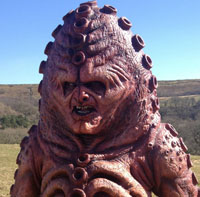 The fourth race on my list of the seven key humanoid ‘monster’ races are the shape-shifting Zygons.
Appearances
The Zygons have a slightly unusual history, compared with those I’ve dealt with so far. They first appear slightly later, during the fourth Doctor story Terror of the Zygons, but that’s not the oddity. They immediately stood out due to a distinctive design and a particularly well-respected debut story and after that they… well, they just didn’t appear again in the classic series. In fact, they didn’t appear on TV again for another 38 years, although they have now shown up as significant antagonists twice in the modern era.
Wednesday, 19 January 2022
D&D Monsters: Devils
 In regular English, the term 'devil', when not applied specifically to Satan, is essentially synonymous with 'demon'. Whereas the word 'demon' originally had a more benign meaning, 'devil' has always meant an evil entity, and now typically means one that is specifically part of the Christian mythos even if the general concept exists in other religions, too.
 In D&D, however, devils are distinct from demons, making up the organised legions of Hell rather than being rampaging creatures of malevolent chaos. In 1E, six main types exist, although other common ones have been added since, all fitting within a defined hierarchy where weaker devils can (with difficulty) be promoted to higher ranks at the whims of those even higher up the chain. Compared with the demons, these six standard types are more likely to owe their origins to myth or at least to traditional depictions of such beings, rather than just being odd combinations of animal parts.
Sunday, 2 January 2022
D&D Monsters: Erinyes

Some versions of the myths state that there are only three Erinyes, but others are much vaguer about the numbers. Notably, the three named Erinyes stand guard over the City of Dis surrounding the Sixth Circle of Hell in Dante's Inferno. It may be this that inspired their adoption as a type of "devil" in D&D, although they (and Dis) are moved to the Second Circle in the 1E Monster Manual, befitting their status as the weakest of the true devils in that edition. Something of a demotion from their mythic origins, then.
Thursday, 30 December 2021
DW Monsters: Ice Warriors

Appearances
The Ice Warriors date all the way back to the Second Doctor’s run, a longer TV history than most of the other races I’ll be dealing with in this first batch. They make their debut in the titular story back in 1967, reappearing in The Seeds of Death in the following season. In the classic series, they reappear twice more, in the two Peladon stories during the Third Doctor’s era. Unusually, having been presented as villains in their earlier appearances, in The Curse of Peladon at least, they are shown to be a more complex race that isn’t necessarily evil, and that actively help the Doctor out. Intended returns during the Sixth and Seventh Doctors’ eras were both cancelled along with their respective seasons, so it was nearly four decades before they re-appeared in the Eleventh Doctor story Cold War, and then once more in Twelve’s run. These are perhaps midway between the Second Doctor stories and The Curse of Peladon in terms of their treatment of the race, playing up the ambiguity.
Sunday, 26 December 2021
D&D Monsters: Demons
 Given that "demon" is such a broad term in real-world mythology and religion, there are inevitably many different interpretations and forms of the beings. They were included in D&D right from 0E, where they are listed simply by a numbered type, increasing in power from one to six. Alternative names are provided in 1E, which become the standard names from 2E onwards. Notably, 2E also tried to pretend that they weren't really "demons", lest that offend anyone religious, and described them instead using the invented word tanar'ri. 3E switched back to "demon" again, explaining that the "tanar'ri" were merely a common subtype; the latter term has largely been deprecated since. 5E restored the numbered type sequence, but only as rarely-used categories of increasing power so that, for example, chasme mosquito-demons are now another example of Type 2 demons, alongside the original hezrou.
Wednesday, 22 December 2021
D&D Monsters: Vrocks
 The word "demon" comes from Ancient Greek where it was used to describe semi-divine beings and generally lacked the negative connotations of the modern word. Early Christians later co-opted it as a term for "servitors of foreign/hostile deities", from which it rapidly morphed into something more explicitly evil. In that sense, it's a common concept in many real-world religions, a generic term not linked to any one in particular and that therefore fits with the typically polytheistic worldview of D&D.
The vrock specifically has no direct antecedents in mythology or in Christian demonology. It may be partly inspired by the demonic Tash from C.S. Lewis's Narnia books, but the resemblance isn't that strong and could be coincidental. Vultures appear in the myths of both African and American cultures since similar birds live on both continents. (In reality, the "vultures" on either side of the Atlantic are not closely related, despite their physical similarity, but this may not be relevant in a fantasy world).
Subscribe to:
Posts (Atom)