Wednesday, 2 March 2022

D&D Monsters: Ropers


The roper is another of the "does what it says on the tin" monsters that are original to D&D. Alongside such creatures as trappers and piercers, it's clearly intended to disguise itself as part of the background and attack unexpectedly but does have a more distinctive look and an unusual method of attack that make it more memorable than they are, with the result that it consistently appears in the core Monster Manual books of each edition.


1E

In the original Monster Manual, the roper is a tapered pillar-like creature with a single large eye above the mouth near the top of the body - there are no apparent nostrils or ears. The eye has an odd brow-like structure that seems to partially cover the upper surface; this might be a ridge to protect it from falling debris, since it lives in caves and there's plausibly a lid that flips down from it as well. The mouth opens horizontally and has pointed isodont teeth in both jaws, although it seems unlikely that the creature has much of an internal skeleton to attach them to. The base is limbless and flat to the ground, while a vertically arranged row of three apparent tentacles arise from each side.

Saturday, 19 February 2022

DW Monsters: Autons

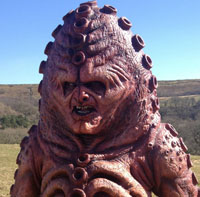
It’s arguably a bit of a stretch to describe the autons as a “humanoid race”, but nonetheless, they are the fifth race I’m going to describe here.

Appearances

The autons make their debut in the first Third Doctor story, Spearhead from Space, making them the third race to appear in my list from that era (which is itself the only era to appear on the list more than once). They reappear only once more in the classic series, in Terror of the Autons at the start of the next season, and twice in the modern series, most notably in the Ninth Doctor’s debut story, Rose.

Outside of the TV series, they featured in a three-part straight-to-video series in the 1990s which, as with Sontarans and Zygons, indicates a certain degree of popularity. That, of course, existed outside the Doctor Who license since autons, like many other original races, have separate copyright status. But in material officially licensed by the BBC, they have so far appeared in three novels, two with the Sixth Doctor, and one with the Tenth. In the audios, they have faced the Doctor only once to date, but they have appeared in a Torchwood audio and a four-part box set featuring UNIT that, in some respects, updates Spearhead from Space for the 2010s. And, as one might expect, there are also a parade of shorter appearances in comics and short stories.

Wednesday, 16 February 2022

D&D Monsters: Mind Flayers

The mind flayer is a creature original to D&D and, like many of Gygax's early creations has a "does what it says on the tin" style name. To my mind, it's one of the better such names - although almost anything is better than, say, "lurker above". The look of the creature is obviously reminiscent of H.P. Lovecraft's Cthulhu, and Gygax stated that it was inspired by the cover of a book by Brian Lumley that does, indeed, feature a being from the Mythos. But, as it happens, it isn't the Big C himself that's on the cover, but a chthonian, a creature with a similar name, to be sure, but actually rather different. Still, it has tentacles and this, seemingly, was enough.


1E

The mind flayer goes through relatively little change in physical appearance through the various editions of the game, to the extent that the few changes that are apparent could easily be put down to variations between individuals of the same species. Even the clothing doesn't change much, with the race clearly having a preference for robes and insisting on a skull motif somewhere on their belt. 

Monday, 24 January 2022

D&D Monsters: Umber Hulks

The origins of the D&D umber hulk are not clear. It predates what we'd now call 1E, first appearing in the Greyhawk supplement, and it has been proposed that it may be based on one of the same set of plastic toys that inspired the owlbear, rust monster, and bulette. If so, it doesn't closely resemble any of them, while the other three are very clearly drawn to resemble the toys in the 1E Monster Manual. So, if it's inspired by them at all, the connection is still vague enough that, to all intents and purposes, it's an original creation. Certainly, its signature power is original, doubtless intended to be related to its unusual appearance and, while evil sorcerers might be able to do something similar in myth, the same is not generally true of monsters.

Saturday, 22 January 2022

DW Monsters: Zygons

The fourth race on my list of the seven key humanoid ‘monster’ races are the shape-shifting Zygons.

Appearances

The Zygons have a slightly unusual history, compared with those I’ve dealt with so far. They first appear slightly later, during the fourth Doctor story Terror of the Zygons, but that’s not the oddity. They immediately stood out due to a distinctive design and a particularly well-respected debut story and after that they… well, they just didn’t appear again in the classic series. In fact, they didn’t appear on TV again for another 38 years, although they have now shown up as significant antagonists twice in the modern era.

Wednesday, 19 January 2022

D&D Monsters: Devils

In regular English, the term 'devil', when not applied specifically to Satan, is essentially synonymous with 'demon'. Whereas the word 'demon' originally had a more benign meaning, 'devil' has always meant an evil entity, and now typically means one that is specifically part of the Christian mythos even if the general concept exists in other religions, too. 

In D&D, however, devils are distinct from demons, making up the organised legions of Hell rather than being rampaging creatures of malevolent chaos. In 1E, six main types exist, although other common ones have been added since, all fitting within a defined hierarchy where weaker devils can (with difficulty) be promoted to higher ranks at the whims of those even higher up the chain. Compared with the demons, these six standard types are more likely to owe their origins to myth or at least to traditional depictions of such beings, rather than just being odd combinations of animal parts. 

Sunday, 2 January 2022

D&D Monsters: Erinyes

The Erinyes originate in Greek myth, where they are goddesses of vengeance cursing kinslayers, oathbreakers, and the like; they are probably better known under their Roman name of "Furies". These original versions appeared as ugly women, typically with snakes entwined in their hair and wrapped around their bodies and limbs. Sometimes they had wings, sometimes not, and later depictions of them are similarly varied.

Some versions of the myths state that there are only three Erinyes, but others are much vaguer about the numbers. Notably, the three named Erinyes stand guard over the City of Dis surrounding the Sixth Circle of Hell in Dante's Inferno. It may be this that inspired their adoption as a type of "devil" in D&D, although they (and Dis) are moved to the Second Circle in the 1E Monster Manual, befitting their status as the weakest of the true devils in that edition. Something of a demotion from their mythic origins, then.