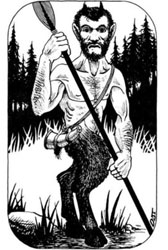
Like centaurs, minotaurs, and harpies, satyrs have their origins in Greek myth. The original versions are wild nature spirits and, in particular, representations of unbridled male sexuality... this survives today in the psychological term 'satyriasis' for uncontrollable sexual desire in men. As with centaurs, this part-bestial nature is represented in their physicality, which combines various animal-like features with an otherwise human, masculine, body.
In later times, the Romans conflated satyrs with fauns, nature spirits from their own mythology that were part-goat part-man. This is quite different from how early Greek art shows them as looking, but it has become essentially universal in western lore since. Nonetheless, since "fauns" lack the rampant sexuality of satyrs, it was their name that C.S. Lewis used in the Narnia books, and his fauns were far more pleasant than Greek satyrs were said to be. Otherwise, "satyr" has generally been the more common term in fantasy, and that's the term that D&D uses.
Saturday, 9 November 2019
Thursday, 25 July 2019
D&D Monsters: Minotaurs
Minotaurs are another creature with their origin in Greek myth. In the original, there was, of course, only one Minotaur, trapped in a labyrinth and slain by Theseus. Contemporary Greek illustrations show a male human with the head and tail of a bull, more obviously a hybrid than the D&D version, but at least broadly similar. However, some of the myths were vague as to exactly what the Minotaur was supposed to look like, and in the Middle Ages an alternative with a centaur-like form, albeit often with horns on the human-like head, started showing up in art. The latter form had some popularity (it was the first illustration of it I saw as a child) but has declined in modern depictions.
Given that crawling around in subterranean labyrinths is part of the point of the original D&D, it's unsurprising that the Minotaur would be included in the game. Here, of course, it becomes a race of beings and thereby loses its capital letter. (As an aside, both "mine-otaur" and "minn-otaur" are legitimate pronunciations in UK English, although the latter seems to be preferred in the US. In Ancient Greek, it was apparently "meen-otaur", so, hey...).
Subscribe to:
Comments (Atom)

