Tuesday, 10 May 2022

D&D Monsters: Golems

The golem is a creature of Jewish myth; a man formed of clay, as Adam was said to have been, and brought to life by a skilled rabbi. This usually involves a holy word, either written on parchment and placed in the golem's mouth or carved directly into its forehead. The resulting golem works as a servitor, and is incapable of speech. In the most famous version of the tale, it eventually goes berserk when its creator forgets to deactivate it on the Sabbath, and it ends up breaking the holy commandment not to work at such times.

In D&D, however, the word is used for a much larger class of creatures, humanoid forms made of pretty well any material and animated to serve their creator. Some of these, too, have a habit of going berserk, although the trigger for doing so is decidedly more random.


Clay Golem

The clay golem is, of course, the one that most closely resembles the being in the original myth. In this respect, it's notable that it has to be created by a powerful priest (and, in, 1E, specifically a priest of a benevolent deity), rather than a wizard or necromancer. In 1E, it is shown as a humanoid figure sculpted from clay and apparently wearing a loincloth. For all we can tell from the picture, this might be a part of the moulded clay, just an artistic convention by its creator, but, from 2E onwards, we're told that a leather jockstrap is an essential accoutrement for all clay golems.

Saturday, 30 April 2022

DW Monsters: The Ambassadors

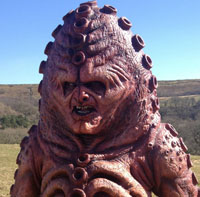
Having completed the seven key humanoid aliens of the show (other than the Time Lords themselves), I’m now going to turn to aliens that appeared less frequently, as well as those that are less humanoid in form. One of the ground rules here is that I will still be looking at races, and not at beings that are said to be unique, or that are unusual or “high level” examples of their kind. I’ll also pass over races that aren’t, in terms of basic game statistics, especially notable, most often because they’re physically indistinguishable from humans.

I’m going to approach this by running through the eras of the various TV incarnations of the Doctor. The first batch consists of “monsters” and other aliens that appear during the Third Doctor’s era, of which there are quite a few.

  •        Spearhead from Space is the Third Doctor’s debut story, and features the autons.
  •         Doctor Who and the Silurians is the debut for the eponymous reptiles.

Wednesday, 27 April 2022

D&D Monsters: Flesh Golems

The flesh golem, as depicted in D&D, is quite clearly based on Frankenstein's Monster. This, of course, has its origin in Mary Shelley's original story, but it's probably fair to say that most people's perceptions of the creature are more heavily influenced by the take on it in the Universal Pictures horror films of the 1930s. So it is with the flesh golem, which owes rather more to the movie version than to that in the novel, despite attempts to transform its look from 2E onwards.


1E

The debt to Frankenstein's Monster is particularly clear in the 1E illustration, which gives the golem the high, almost cylindrical head seen in the 1930s film version. Otherwise, the golem is an animated humanoid apparently stitched together from pieces of human body; it is hairless with a lantern jaw and distinct brow ridges. It is stated to be 7½ feet (230cm) tall which, given that this is obviously taller than the vast majority of humans, implies that either the magical process which creates it enlarges the original body parts or that multiple pieces are grafted together to make the body. 

Wednesday, 20 April 2022

D&D Monsters: Pixies

Pixies are a form of fairy originally found in the folklore of southwest England, specifically Devon and Cornwall. They are typically more benign than many other fairies, but still mischievous and inclined to cause trouble for humans. In D&D, they were one of four races of fairy-like beings in the original Monster Manual, and seem to be intended as a bit of light-hearted relief, a potentially humorous inconvenience, rather than dangerous monsters to be slain. Of the four originals, they are the only ones to remain in the core monster books for both third and fifth editions.


1E

As originally described, pixies look much like elves, except for being only 2'6" (75cm) tall. Or at least, that's what the text says, since the pixie in the picture looks a lot smaller than this. Assuming that the stated figure is accurate, however, it's still a good four inches (10 cm) shorter than a typical two-year-old human child. This makes them the tallest of the four fairy races, and far closer in height to a halfling than, say, a dwarf is to a human.  More distinctively, of course, they have two pairs of wings projecting from their back, which look to be similar to those of a dragonfly. 

Saturday, 16 April 2022

DW Monsters: Ood

The final race on my initial list of key humanoid ‘monster’ races is also the only one unique to the modern era of the show. (I’m not currently planning on suspending the series after this post, although it will remain low priority; I’ll explain where it’s going next once I get there).

Appearances

By far the most recent of the seven races I’m listing as key humanoids in this series, the Ood made their debut in the Tenth Doctor story The Impossible Planet in 2006, over 30 years after the next oldest on that list. They returned two years later in Planet of the Ood, in which we learn of their origin, and have made significant appearances in three further TV stories since then, most recently Flux. That’s ignoring short “tardisodes” and the like, some of which have also featured them, and the occasional brief cameo elsewhere.

Wednesday, 13 April 2022

D&D Monsters: Couatls

The couatl has its basis in Mesoamerican mythology, although it's arguable how much it resembles the original. The name is apparently inspired by that of the Aztec god Quetzalcoatl the "feathered serpent". In reality, coatl simply means "snake" so it doesn't refer to any specific mythic creature taken on its own. Having said that, snakes were important to the Mesoamerican people, and associated with many of their gods. In particular, several of them were feathered, magically merging the features of a flying creature with one that crawls along the ground. They seem to have been regarded as divine beings, which fits with the original 1E description of their habitat and relationship with humans.


1E

As originally seen, the couatl has a head and body that closely resemble those of a regular snake. While the presence of an extra set of teeth between the fangs is unusual, in other respects, the arrangement of the teeth resembles those of snakes such as cobras, kraits, and mambas, rather than say, rattlesnakes or boomslangs. While the head is at least partially covered with scales like that of a normal snake, the couatl's body is feathered, with longer feathers along the back and what appear to be softer, downy, ones on the underside. 

Wednesday, 6 April 2022

D&D Monsters: Beholders

The beholder is, perhaps, the single most iconic monster in D&D - the one creature that, more than any other, says "this is D&D" rather than some other fantasy setting. That's largely due to its unique appearance, which is quite unlike anything that exists in myth or legend or, indeed, in prior fiction. It was created, not by Gygax, but by one of the players in his original campaign, first appearing in a supplement for 0E, and has successfully stood the test of time ever since.


1E

As originally shown, the beholder is a spherical creature covered in irregular, flat, "chitinous" plates. A wide mouth occupies much of the lower half and is lined with small pointed teeth similar to those of reptiles. There is a single large lidless eye above the mouth and ten much smaller eyestalks arranged in a ring around the upper surface. The latter are protected by segmented chitin and have also have lidless eyes, similar to those of a snail or slug, although the eyestalks presumably aren't retractable. Severing the eyestalks doesn't otherwise hurt the creature, which suggests that it's able to shut off the blood supply to a severed stalk - or perhaps that it doesn't have blood. There are no other visible features, such as nostrils.

Wednesday, 23 March 2022

DW Monsters: Cybermen

Mk V
The Cybermen are surely second only to the Daleks as iconic Doctor Who monsters. It also seems to me that they are most significant such race that could be described as “humanoid”, and so are arguably overdue for an appearance here in my list of key races in that category.

This one, by the way, is going to be a long post. There’s a lot to cover!

Note: Since I started this series of posts, Cubicle 7 have announced a 5E version of their existing Doctor Who RPG. I'll continue posting my 5E interpretation of stats here, at least for the time being. Although it's likely they'll be very different from the "official" versions, not least because there will presumably be some difference in the fine details of the systems, these posts do at least include my reasoning.

Appearances

The Cybermen have the distinction of being the first “monster” other than the Daleks to appear in more than one story. They are also the oldest of the races in my pick of the top seven humanoid monsters, dating back all the way to the First Doctor’s era and his final story The Tenth Planet. Frequently re-invented since that first appearance, they appear no less than four times in the Second Doctor’s era (whereas the Daleks only appear twice). The Third Doctor is the only classic-era Doctor not to have a TV story featuring them, with Doctors Four to Seven having one major Cyberman story each, not counting their brief appearance in The Five Doctors. Skipping the Eighth and Ninth Doctors because of their short runs, every modern Doctor from Ten onwards has faced them. In total, that’s 23 stories featuring Cybermen as more than brief clips or mentions.

Thursday, 17 March 2022

D&D Monsters: Otyughs

There has been some speculation that the otyugh is based on the tentacled monster in the trash compactor in the first Star Wars film (referred to in the tie-in material as a "dianoga"). Certainly, there is a resemblance, especially given that we don't see the whole creature in the film; based on that alone, the rest of the body could look like almost anything. On the other hand, the film only came out a few months before the otyugh made its debut so it would have to have been a very last-minute addition to the 1E Monster Manual if that really was the source. More likely, it's a coincidence, leaving the D&D monster as an original creation.

Wednesday, 2 March 2022

D&D Monsters: Ropers


The roper is another of the "does what it says on the tin" monsters that are original to D&D. Alongside such creatures as trappers and piercers, it's clearly intended to disguise itself as part of the background and attack unexpectedly but does have a more distinctive look and an unusual method of attack that make it more memorable than they are, with the result that it consistently appears in the core Monster Manual books of each edition.


1E

In the original Monster Manual, the roper is a tapered pillar-like creature with a single large eye above the mouth near the top of the body - there are no apparent nostrils or ears. The eye has an odd brow-like structure that seems to partially cover the upper surface; this might be a ridge to protect it from falling debris, since it lives in caves and there's plausibly a lid that flips down from it as well. The mouth opens horizontally and has pointed isodont teeth in both jaws, although it seems unlikely that the creature has much of an internal skeleton to attach them to. The base is limbless and flat to the ground, while a vertically arranged row of three apparent tentacles arise from each side.

Saturday, 19 February 2022

DW Monsters: Autons

It’s arguably a bit of a stretch to describe the autons as a “humanoid race”, but nonetheless, they are the fifth race I’m going to describe here.

Appearances

The autons make their debut in the first Third Doctor story, Spearhead from Space, making them the third race to appear in my list from that era (which is itself the only era to appear on the list more than once). They reappear only once more in the classic series, in Terror of the Autons at the start of the next season, and twice in the modern series, most notably in the Ninth Doctor’s debut story, Rose.

Outside of the TV series, they featured in a three-part straight-to-video series in the 1990s which, as with Sontarans and Zygons, indicates a certain degree of popularity. That, of course, existed outside the Doctor Who license since autons, like many other original races, have separate copyright status. But in material officially licensed by the BBC, they have so far appeared in three novels, two with the Sixth Doctor, and one with the Tenth. In the audios, they have faced the Doctor only once to date, but they have appeared in a Torchwood audio and a four-part box set featuring UNIT that, in some respects, updates Spearhead from Space for the 2010s. And, as one might expect, there are also a parade of shorter appearances in comics and short stories.

Wednesday, 16 February 2022

D&D Monsters: Mind Flayers

The mind flayer is a creature original to D&D and, like many of Gygax's early creations has a "does what it says on the tin" style name. To my mind, it's one of the better such names - although almost anything is better than, say, "lurker above". The look of the creature is obviously reminiscent of H.P. Lovecraft's Cthulhu, and Gygax stated that it was inspired by the cover of a book by Brian Lumley that does, indeed, feature a being from the Mythos. But, as it happens, it isn't the Big C himself that's on the cover, but a chthonian, a creature with a similar name, to be sure, but actually rather different. Still, it has tentacles and this, seemingly, was enough.


1E

The mind flayer goes through relatively little change in physical appearance through the various editions of the game, to the extent that the few changes that are apparent could easily be put down to variations between individuals of the same species. Even the clothing doesn't change much, with the race clearly having a preference for robes and insisting on a skull motif somewhere on their belt. 

Monday, 24 January 2022

D&D Monsters: Umber Hulks

The origins of the D&D umber hulk are not clear. It predates what we'd now call 1E, first appearing in the Greyhawk supplement, and it has been proposed that it may be based on one of the same set of plastic toys that inspired the owlbear, rust monster, and bulette. If so, it doesn't closely resemble any of them, while the other three are very clearly drawn to resemble the toys in the 1E Monster Manual. So, if it's inspired by them at all, the connection is still vague enough that, to all intents and purposes, it's an original creation. Certainly, its signature power is original, doubtless intended to be related to its unusual appearance and, while evil sorcerers might be able to do something similar in myth, the same is not generally true of monsters.

Saturday, 22 January 2022

DW Monsters: Zygons

The fourth race on my list of the seven key humanoid ‘monster’ races are the shape-shifting Zygons.

Appearances

The Zygons have a slightly unusual history, compared with those I’ve dealt with so far. They first appear slightly later, during the fourth Doctor story Terror of the Zygons, but that’s not the oddity. They immediately stood out due to a distinctive design and a particularly well-respected debut story and after that they… well, they just didn’t appear again in the classic series. In fact, they didn’t appear on TV again for another 38 years, although they have now shown up as significant antagonists twice in the modern era.

Wednesday, 19 January 2022

D&D Monsters: Devils

In regular English, the term 'devil', when not applied specifically to Satan, is essentially synonymous with 'demon'. Whereas the word 'demon' originally had a more benign meaning, 'devil' has always meant an evil entity, and now typically means one that is specifically part of the Christian mythos even if the general concept exists in other religions, too. 

In D&D, however, devils are distinct from demons, making up the organised legions of Hell rather than being rampaging creatures of malevolent chaos. In 1E, six main types exist, although other common ones have been added since, all fitting within a defined hierarchy where weaker devils can (with difficulty) be promoted to higher ranks at the whims of those even higher up the chain. Compared with the demons, these six standard types are more likely to owe their origins to myth or at least to traditional depictions of such beings, rather than just being odd combinations of animal parts. 

Sunday, 2 January 2022

D&D Monsters: Erinyes

The Erinyes originate in Greek myth, where they are goddesses of vengeance cursing kinslayers, oathbreakers, and the like; they are probably better known under their Roman name of "Furies". These original versions appeared as ugly women, typically with snakes entwined in their hair and wrapped around their bodies and limbs. Sometimes they had wings, sometimes not, and later depictions of them are similarly varied.

Some versions of the myths state that there are only three Erinyes, but others are much vaguer about the numbers. Notably, the three named Erinyes stand guard over the City of Dis surrounding the Sixth Circle of Hell in Dante's Inferno. It may be this that inspired their adoption as a type of "devil" in D&D, although they (and Dis) are moved to the Second Circle in the 1E Monster Manual, befitting their status as the weakest of the true devils in that edition. Something of a demotion from their mythic origins, then.

Thursday, 30 December 2021

DW Monsters: Ice Warriors

Third on my list of regularly appearing humanoid races are the Ice Warriors, another reptilian race, but notably different from the Silurians.

Appearances

The Ice Warriors date all the way back to the Second Doctor’s run, a longer TV history than most of the other races I’ll be dealing with in this first batch. They make their debut in the titular story back in 1967, reappearing in The Seeds of Death in the following season. In the classic series, they reappear twice more, in the two Peladon stories during the Third Doctor’s era. Unusually, having been presented as villains in their earlier appearances, in The Curse of Peladon at least, they are shown to be a more complex race that isn’t necessarily evil, and that actively help the Doctor out. Intended returns during the Sixth and Seventh Doctors’ eras were both cancelled along with their respective seasons, so it was nearly four decades before they re-appeared in the Eleventh Doctor story Cold War, and then once more in Twelve’s run. These are perhaps midway between the Second Doctor stories and The Curse of Peladon in terms of their treatment of the race, playing up the ambiguity.

Sunday, 26 December 2021

D&D Monsters: Demons

Given that "demon" is such a broad term in real-world mythology and religion, there are inevitably many different interpretations and forms of the beings. They were included in D&D right from 0E, where they are listed simply by a numbered type, increasing in power from one to six. Alternative names are provided in 1E, which become the standard names from 2E onwards. Notably, 2E also tried to pretend that they weren't really "demons", lest that offend anyone religious, and described them instead using the invented word tanar'ri. 3E switched back to "demon" again, explaining that the "tanar'ri" were merely a common subtype; the latter term has largely been deprecated since. 5E restored the numbered type sequence, but only as rarely-used categories of increasing power so that, for example, chasme mosquito-demons are now another example of Type 2 demons, alongside the original hezrou.

Wednesday, 22 December 2021

D&D Monsters: Vrocks

The word "demon" comes from Ancient Greek where it was used to describe semi-divine beings and generally lacked the negative connotations of the modern word. Early Christians later co-opted it as a term for "servitors of foreign/hostile deities", from which it rapidly morphed into something more explicitly evil. In that sense, it's a common concept in many real-world religions, a generic term not linked to any one in particular and that therefore fits with the typically polytheistic worldview of D&D.

The vrock specifically has no direct antecedents in mythology or in Christian demonology. It may be partly inspired by the demonic Tash from C.S. Lewis's Narnia books, but the resemblance isn't that strong and could be coincidental. Vultures appear in the myths of both African and American cultures since similar birds live on both continents. (In reality, the "vultures" on either side of the Atlantic are not closely related, despite their physical similarity, but this may not be relevant in a fantasy world).

Saturday, 27 November 2021

DW Monsters: Silurians

Following on from the Sontarans, I’m going to look at six other humanoid races that have made regular or semi-regular appearances on the show. I’ll start with the Silurians.

Appearances

The Silurians make their debut in the somewhat oddly titled Third Doctor story Doctor Who and the Silurians. This establishes many of the basics of the race, including the ambiguity about whether they count as ‘evil monsters’ or not. In the later Third Doctor story The Sea Devils, it becomes clear that there are multiple forms of their race, although the Sea Devils themselves are sufficiently different from the baseline Silurians that I’m going to leave them for a later post. The Silurians make a final classic series appearance during the Fifth Doctor’s run in Warriors of the Deep, teaming up with the Sea Devils. In the modern show, they’ve only really appeared as villains once, in the Eleventh Doctor story The Hungry Earth, which partly mirrors the plot of their original story. They have also been mentioned and made brief appearances in other stories, even if we ignore Madame Vastra.

Friday, 26 November 2021

D&D Monsters: Nagas

Nagas originate in Hindu mythology, in which they are magical beings that can take on various snake-like forms. Some appear as literal snakes and, indeed, the scientific name of the main cobra genus is Naja, based on the Sanskrit word for 'cobra'. Similarly, it's no coincidence that the feminine form of this word is "nagini" - although the exact English spelling can vary.

Often capable of shape-shifting, mythic nagas can take on fully human or partially humanoid form, with the latter more usually resembling the yuan-ti and mariliths of D&D than the shape seen in the game (although this is not unknown). Nagas are generally said to be righteous, if not exactly benevolent, and are often set to guard the treasures of the gods, hence at least the 'guardian nagas' of D&D.

Wednesday, 17 November 2021

D&D Monsters: Sphinxes

The sphinx is a creature of Greek myth, taking the form of a winged lion with a human face. In the original myths, she is, like the minotaur and many others, a unique creature, and appears most famously in the story of Oedipus. 

Confusingly, however, the term was retrospectively employed (possibly by the Greeks themselves) to also refer to the wingless lion-bodied statues of Ancient Egypt. These aren't the same thing as the Greek monster, and it isn't known what the Egyptians actually called them. They were usually, but not always, male and, judging from the statuary, were probably perceived as good and noble beings, unlike the much more hostile Greek creation. 

It seems to be the case that, in D&D, the male or "androsphinx" was based largely on the Egyptian creature (albeit with the addition of wings), while the female or "gynosphinx" has closer links with the Greek version.

Sunday, 14 November 2021

DW Monsters: Sontarans

I'm going to kick off this series with the Sontarans. That's partly because they've just been heavily featured in a new episode as I write this, but also because they are one of the races with the greatest potential for stories. They could even be adapted for other SF settings with a few serial numbers filed off. For that matter, they would make decent player characters, but I'm describing them here only as opponents since player rules would involve game balance considerations beyond the scope of these posts.

To begin with, let’s list the available source material, then look at what we know about this particular race.