Showing posts with label fey. Show all posts

Wednesday, 20 April 2022

D&D Monsters: Pixies

Pixies are a form of fairy originally found in the folklore of southwest England, specifically Devon and Cornwall. They are typically more benign than many other fairies, but still mischievous and inclined to cause trouble for humans. In D&D, they were one of four races of fairy-like beings in the original Monster Manual, and seem to be intended as a bit of light-hearted relief, a potentially humorous inconvenience, rather than dangerous monsters to be slain. Of the four originals, they are the only ones to remain in the core monster books for both third and fifth editions.


1E

As originally described, pixies look much like elves, except for being only 2'6" (75cm) tall. Or at least, that's what the text says, since the pixie in the picture looks a lot smaller than this. Assuming that the stated figure is accurate, however, it's still a good four inches (10 cm) shorter than a typical two-year-old human child. This makes them the tallest of the four fairy races, and far closer in height to a halfling than, say, a dwarf is to a human.  More distinctively, of course, they have two pairs of wings projecting from their back, which look to be similar to those of a dragonfly. 

Saturday, 18 January 2020

D&D Monsters: Dryads

Looking again at D&D creatures derived from Greek myth, we come to the dryad. In the original myths, dryads are a type of nymph, or female nature spirit, associated with trees. Originally, the tree specifically had to be an oak tree, but later on the term seems to have been used more broadly for woodland spirits in general. The term "hamadryad" was used for a dryad so closely bonded to her tree ("hama" means "together") that she would die if it did, but others seemingly had no such vulnerability. So far as one can tell, they were supposed to look like regular human women.

Dryads have occasionally appeared in works of fantasy fiction, most notably in C.S. Lewis' Narnia books, which maintains the distinction from hamadryads. In D&D, dryads and nymphs are different kinds of being, albeit with a number of similarities, but the latter did not make it into the 5E Monster Manual, something that's currently one of my criteria for including something in this series. In the first few editions they are, however, said to be "tree sprites"... but it's not clear what this means, since a sprite is yet another distinct creature in D&D, and one that resembles dryads rather less than nymphs do.

Saturday, 9 November 2019

D&D Monsters: Satyrs

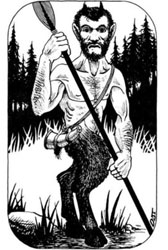
Like centaurs, minotaurs, and harpies, satyrs have their origins in Greek myth. The original versions are wild nature spirits and, in particular, representations of unbridled male sexuality... this survives today in the psychological term 'satyriasis' for uncontrollable sexual desire in men. As with centaurs, this part-bestial nature is represented in their physicality, which combines various animal-like features with an otherwise human, masculine, body.

In later times, the Romans conflated satyrs with fauns, nature spirits from their own mythology that were part-goat part-man. This is quite different from how early Greek art shows them as looking, but it has become essentially universal in western lore since. Nonetheless, since "fauns" lack the rampant sexuality of satyrs, it was their name that C.S. Lewis used in the Narnia books, and his fauns were far more pleasant than Greek satyrs were said to be. Otherwise, "satyr" has generally been the more common term in fantasy, and that's the term that D&D uses.